






Last Updated on March 31, 2026 2:48 pm
HIGH COUNTRY — A new study from the University of North Carolina's Kenan Institute of Private Enterprise confirms what many High Country residents already know firsthand: buying a home here has become nearly impossible for the average household, and Watauga County is in the worst position of any county in North Carolina.
The study, “Housing Affordability in North Carolina,” published January 29, 2026, develops a housing affordability index for all 100 North Carolina counties based on three factors — home prices, mortgage rates, and household income. The index is calibrated so that a score of 100 means a median-priced home is exactly affordable for the median household, using the federal Department of Housing and Urban Development's standard that housing should cost no more than 30 percent of gross income. Scores above 100 indicate housing is affordable; scores below 100 indicate it is not.
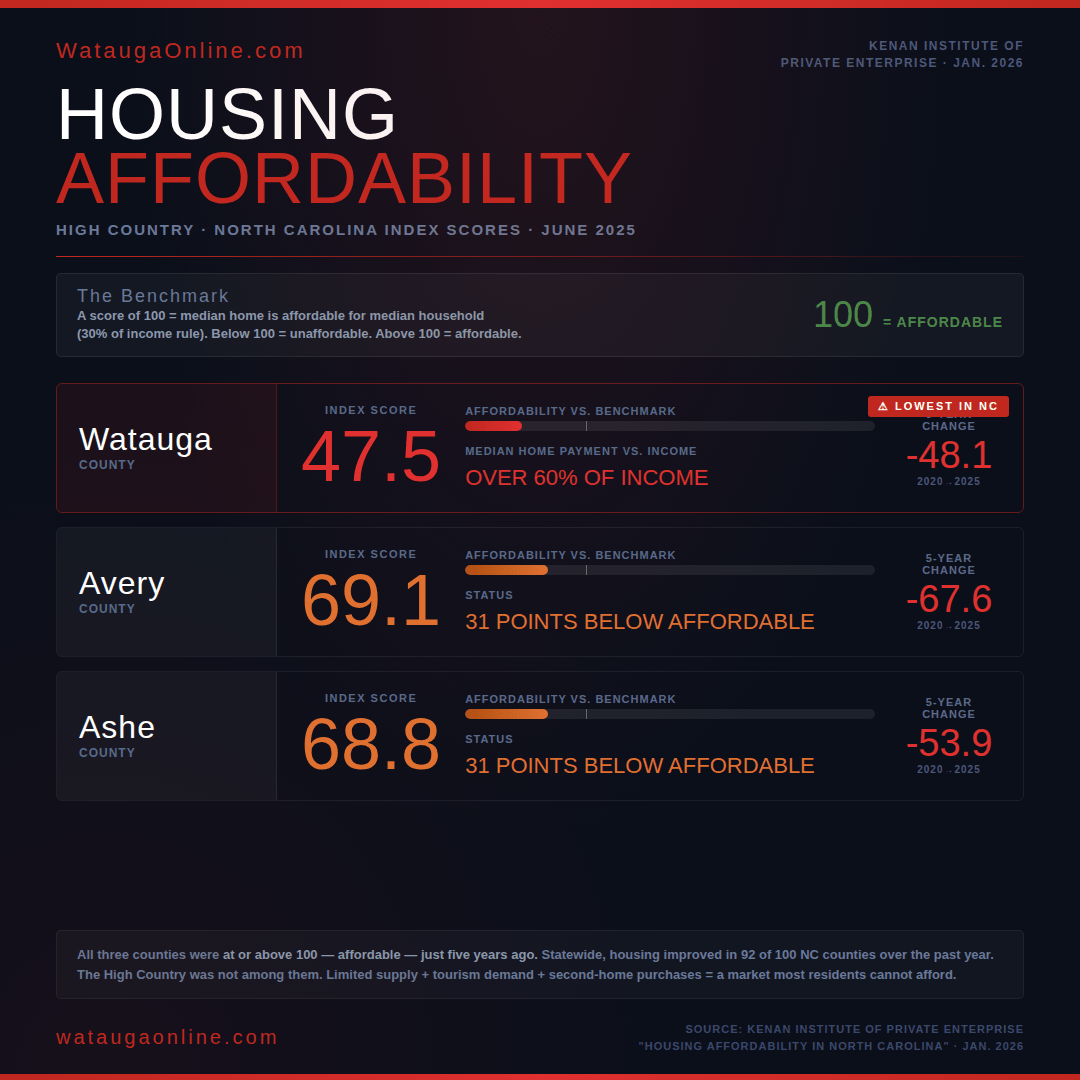
Watauga County's latest index score is 47.5 — the lowest of all 100 counties in North Carolina. That means the median home payment in Watauga County consumes more than 60 percent of median household income, more than double the standard threshold for affordability. The county that ranks most affordable in the state, Bertie County in northeastern North Carolina, has an index of 341.
Ashe and Avery counties, the other core counties in WataugaOnline's coverage area, fare only slightly better. Ashe County's latest index is 68.8, and Avery County's is 69.1 — both well below the affordability threshold and among the least affordable counties in the state.
The five-year decline in affordability across the High Country tells an even starker story. From June 2020 to June 2025, Watauga County's index fell by 48.1 points, Ashe County's fell by 53.9 points, and Avery County's fell by 67.6 points. In each case, the index was at or above 100 — meaning housing was essentially affordable — at the start of that period. The collapse happened rapidly beginning in 2021 and 2022, driven by pandemic-era supply chain disruptions, a surge of new residents moving to attractive mountain destinations, and the Federal Reserve's aggressive interest rate increases to combat inflation.
The Kenan Institute study notes that the least affordable counties in North Carolina tend to be concentrated in the mountains and along the coast, where limited housing supply combines with strong demand driven by natural amenities, tourism, and second-home purchases. That dynamic describes the High Country precisely.
“In many mountain and coastal counties, a significant share of homeowners earn income elsewhere or are purchasing second homes,” the study states. “This effect creates housing markets that are fundamentally different from those in many Piedmont counties, where owner-occupied primary residences dominate.”
Statewide, conditions have shown modest improvement. The NC affordability index rose from 84 in November 2023 to 96 as of June 2025, and housing became more affordable in 92 of North Carolina's 100 counties over the past year. The High Country counties remain stuck far below 100, with no comparable recovery.
The Kenan Institute notes that its index is best understood as a high-level summary of housing market pressures rather than a complete measure of housing access. It focuses on the median household and median home price, does not capture variation across income levels, and excludes some costs such as property insurance.
The full study, including interactive county-by-county maps, is available at kenaninstitute.unc.edu/kenan-insight/housing-affordability-in-north-carolina/