







Last Updated on November 29, 2026 6:57 am
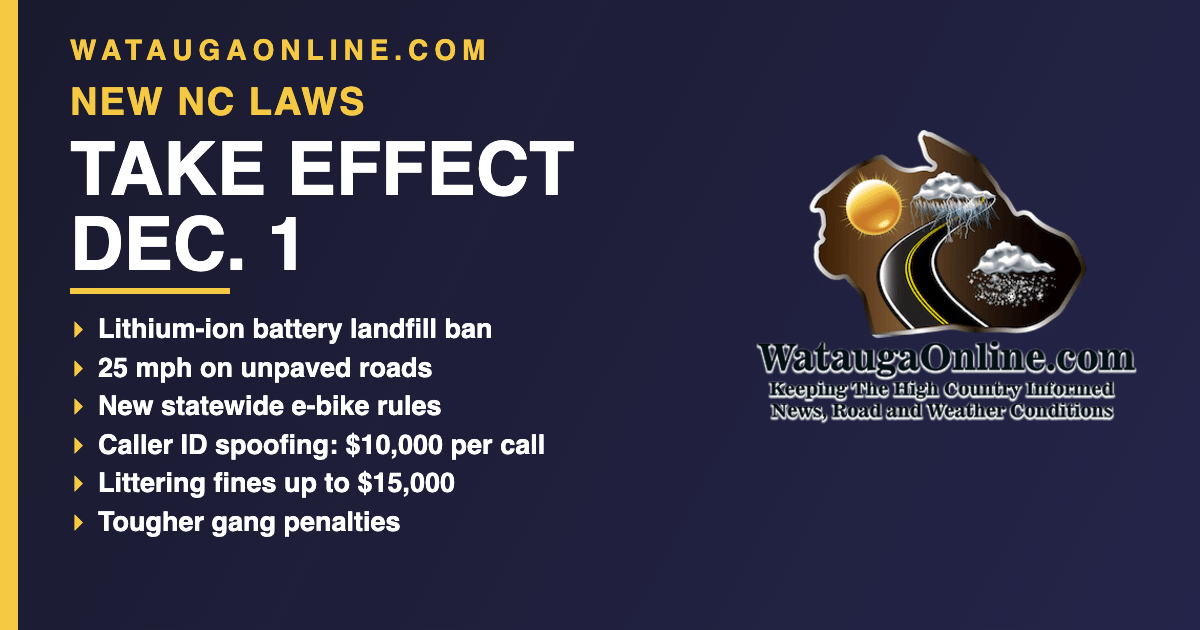
Several new North Carolina laws take effect Tuesday, Dec. 1, changing how residents dispose of rechargeable batteries, how fast they can drive on some rural roads, where e-bikes can go and what happens to people who spoof phone numbers or litter.
Lithium-ion batteries banned from landfills
Lithium-ion batteries can no longer be thrown away in household trash or taken to landfills or permitted incinerators. The ban, part of G.S. 130A-309.10, covers rechargeable batteries in everyday items such as cellphones, electric toothbrushes, shavers and blenders. Damaged lithium-ion batteries can overheat in a chain reaction known as thermal runaway.
The N.C. Department of Environmental Quality says residents should take the batteries to a designated drop-off point, such as a household hazardous waste program, a local government recycling program or a drop-off location listed in Call2Recycle’s locator. News reports on the law did not mention fines.
Watauga County’s solid waste page says household batteries are accepted at all 10 county convenience centers, and the county’s household hazardous waste facility is at 336 Landfill Road in Boone. The page does not specifically mention lithium-ion batteries, so residents should call Watauga County Solid Waste before dropping them off.
25 mph on unpaved roads, new e-bike rules
A transportation bill (House Bill 1094, S.L. 2026-46) sets a default speed limit of 25 mph on roads that are unpaved or have no centerline, unless signs post a different limit.
The same law changes the left-lane rule for large trucks. News reports say trucks weighing 26,001 pounds or more are barred from the far-left lane on controlled-access highways with six or more lanes, with exceptions for entering, exiting or avoiding a hazard. According to the General Assembly’s summary, the change removes an exception for passing.
For electric bicycles, the law adopts the federal three-class definition. E-bikes are allowed on roadways, bike lanes and multiuse paths statewide, unless a city, local government or the state Department of Natural and Cultural Resources sets other rules. Riders and passengers under 18 on Class 3 e-bikes must wear helmets. Local governments may regulate e-bike use on multiuse paths and sidewalks and may require helmets for riders and passengers under 18 on Class 1 and Class 2 e-bikes.
The law also allows larger personal delivery devices, up to 55 inches long and 36 inches wide, and lets them operate on highways with speed limits up to 55 mph.
Phone spoofing, littering and other consumer changes
Telephone solicitors may no longer send misleading information to caller ID systems or disguise where a call comes from. A subscriber who receives such a call can sue for $10,000 for each call placed in knowing violation. Phone carriers may not knowingly provide subscriber numbers to someone they know will use them to break the law. The rule applies to calls placed on or after Dec. 1 (S.L. 2026-59).
The same law raises fines for intentional or reckless littering, based on the amount dumped. Penalties range from $1,000 to $3,000 for a first offense involving less than 10 pounds up to $10,000 to $15,000 for more than 500 pounds or littering for a commercial purpose. It also raises the civil liability cap for unlawful water connections, including to fire hydrants, to triple the losses or $10,000, whichever is greater.
The fee to file for an absolute divorce rises from $75 to $125, with the money going to the Domestic Violence Center Fund (S.L. 2026-41).
Gang law and other criminal changes
Jaleeyah’s Law (House Bill 1173, S.L. 2026-37) increases penalties for gang-related crimes. According to the UNC School of Government, most felonies committed as criminal gang activity will be punished two classes higher, and gang leaders three classes higher. Soliciting a minor to join gang activity becomes a Class D felony. The number of criteria needed to establish gang membership drops from three to two. The law creates new firearm offenses for gang members and applies to offenses committed on or after Dec. 1. It is named for 13-year-old Jaleeyah “Lee Lee” Tune, who was killed in Goldsboro. Some Democrats opposed the bill over free-expression concerns.
Another law (House Bill 83, S.L. 2026-34) makes giving obscene material to a minor a Class H felony when the offender is at least four years older, and requires courts to consider whether a convicted person is dangerous and should register as a sex offender.
The state budget bill (S.L. 2026-41) bars certain registered sex offenders from seasonal child care camps, raises damage to critical infrastructure to a Class C felony, adds money laundering and adult human trafficking to the offenses eligible for electronic surveillance orders, and ends state financial aid for UNC students convicted of assaulting state or local government employees.
A farm bill (S.L. 2026-11) raises penalties for repeat offenders who steal crops or rob or injure aquaculture operations, from a Class H to a Class G felony, with added fines of $250 for a first offense and $500 for later offenses. News reports described the change as making aquaculture theft a felony.
Additional provisions also take effect Dec. 1, including an inpatient capacity restoration program in the involuntary commitment process, emergency propane tank refill rules, and an exemption from financial assurance requirements for some compost facilities.