








Last Updated on September 10, 2026 11:32 am
Online slot machine-style games are driving a surge in North Carolina Education Lottery sales while shrinking the share of proceeds that reach the state’s Education Fund, according to a new performance audit from the North Carolina Office of the State Auditor.
Between fiscal years 2023 and 2025, the lottery’s reported gross sales jumped from $4.3 billion to $6.6 billion, a 51% increase in two years. Over that same span, the percentage of sales transferred to the Education Fund fell from 23% to 16%. Actual dollars transferred still rose, from $1.02 billion in FY 2023 to $1.09 billion in FY 2024, before dipping slightly to $1.08 billion in FY 2025.
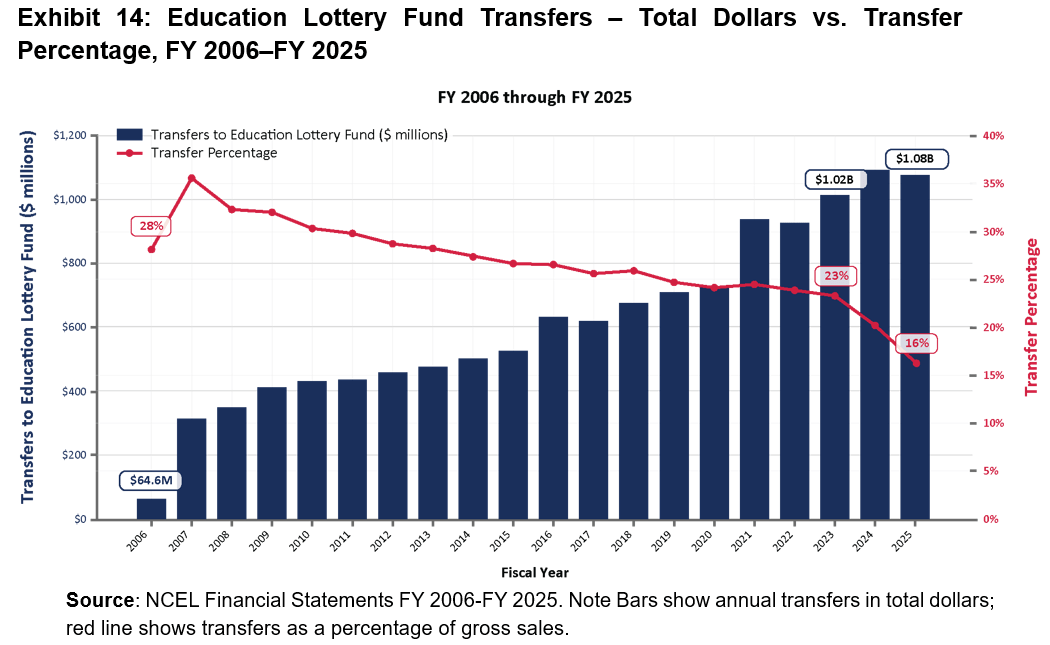
Auditors found that rapid growth in “digital instant games” — high-payout online games that mimic casino slot machines — combined with falling sales of traditional scratch-off and draw games, is the primary cause of the shrinking transfer percentage. The online games carry an 87% prize payout rate, leaving fewer cents per dollar available for the Education Fund.
“Last December, the State Auditor’s Office released a financial audit of the Education Lottery, and we were left with questions on the amount of money going toward our public schools,” said State Auditor Dave Boliek. “With the release of this performance audit, we found that gambling trends have dramatically shifted. New online slot machine gaming, which has an 87% payout rate, now dominates the market. Online slot machine gaming grew from generating 0% of the Education Lottery’s revenue to 40% in just three years. The Education Lottery today isn’t what it used to be, prompting auditors to recommend the primary policy objective of the lottery be revisited.”
The online games went from $0 in sales in FY 2023 to $2.6 billion in FY 2025, while scratch-off and draw game revenue fell from about $4.3 billion to just under $4 billion over the same period. Similar trends have appeared in Kentucky and Virginia following the introduction of comparable online games.
State law sets a target for the lottery to contribute roughly 38% of revenue to the Education Fund “to the extent practicable,” though the target isn’t a statutory requirement. Despite routinely missing that mark, total dollars transferred each year have historically continued to increase.
Other findings from the audit: a total of $12.3 billion has gone to education programs since the lottery’s inception through FY 2025; the lottery spent $54 million on advertising and marketing and $125 million on its three main gaming-system vendors in FY 2025, with total vendor expenses reaching $207 million; and the retailer with the highest lottery sales statewide was located in Brunswick County.
Auditors recommended the lottery work with the General Assembly to clarify its primary strategic objective — whether to maximize total dollars transferred to schools, maintain a minimum transfer percentage, or balance both through a defined policy framework. Lottery leadership has committed to reviewing the audit with its commission and meeting with legislative leaders on possible changes.